February 23, 2007

Gender in Cancer Science. Two quick points for discussion on a boring Friday afternoon.


It's been known for a while now that increased exercise decreases women's breast cancer risk. However, in the January 2007 edition of Cancer Epidemiology Biomarkers & Prevention (I'm sure everyone here has a subscription), a group of German researchers discovered that only household activity had a significant effect on breast cancer risk. Occupational and recreational exercise made absolutely no difference. The study looked at over 200,000 women of varying ages, demographics, and nationality, so it's hard to really argue with many of their methods. And, like many Epidemiology studies, don't really give an explanation as to why this could happen.

This whole thing seems fishy to me, as I don't see why mopping floors would have an different effect on the body, then say, walking up stairs. Maybe it's the cleaning product? And I'm not sure it has much to do with the male-dominated science industry -- the main author on the study is a woman.

On another note of issue is the recent news that Merck will stop lobbying for mandatory support of its new HPV vaccine, Gardasil. Human papillomavirus has many subtypes, but the sexually transmitted kind has been linked to cervical cancer. Merck seems to be afraid of the fundamentalist backlash -- getting this vaccine would, of course, only encourage young women to engage in promiscuous sex, as there would no longer be any reason not to. Never mind the fact that this may prevent nearly 7,000 women a year from getting cervical cancer (note: this is my own rough number, figuring % vaccine success and # of new cases/year).

Is there any reason I'm missing as to why you wouldn't you give your daughter an HPV vaccine? Why don't elected governmental representatives have the courage to stand up for what's right? If this was a vaccine for a male-dominated disease, would the government treat it differently? Though it's really unfair that increased sexually activity seems to diminish the prostate cancer risk. Girls get it rough sometimes.

February 19, 2007

FOOD: Lentil and Sweet Potato Soup

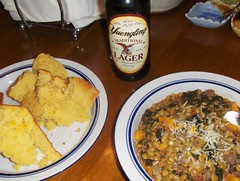
I modified this recipe from Real Simple magazine. Pretty tasty. Since lentils are so small and have a relatively high surface area, the dried beans take less than an hour to cook and soaking isn't necessary. Just spill them out on a cookie sheet for a quick rinse and to make sure that you didn't get any pebbles or chunks of dirt. The original recipe called for fresh thyme and basil, but i didn't have any and used half the amount of dried herbs. If anything, increase the amount of the sweet potatoes. they're the best part. Good with beer and cornbread, as shown in Figure 1.

4 leeks, white and light green parts only
1 bunch kale
1 tablespoon olive oil
1 28-ounce can whole tomatoes, drained (Not sure if i drained this or not. Can't see how a little tomato juice would hurt anything.)
6 cups water (for maximum tastiness, I used half water and half veggie broth)
2 sweet potatoes, peeled and cut into a 1/2-inch dice
1/2 cup brown lentils
1/2 tablespoon dried leaves
1/2 tablespoon dried basil
2 teaspoons kosher salt
1/4 teaspoon black pepper
1/4 cup (1 ounce) grated Parmesan (optional)

Slice each leek in half lengthwise, then slice each half into 1/4-inch-thick half-moons (about 2 cups). Place in a large bowl of cold water and swish to remove any grit. Drain and pat dry.

Remove the stems from the kale. Stack the leaves on top of one another and slice them crosswise into 1/2-inch-wide strips; you'll need 3 cups.

Heat the oil in a saucepan over medium heat. Add the leeks and cook for 3 minutes. Add the tomatoes and cook, breaking them up with a spoon, for 5 minutes. Add the water and bring to a boil. Stir in the kale, sweet potatoes, lentils, thyme, salt, pepper, and basil (if using). Simmer until the lentils are tender, about 30 minutes. Spoon into individual bowls. Sprinkle with the Parmesan (if using).

Serves: one metric ton. If you need to freeze it, omit the cheese.

February 5, 2007

Still no baking soda volcanoes. (Science fair part II)

So day #2 didn't take long. The winners from last week, along with winners from another school presented their topics with a 10-12 minute Powerpoint presentation. I was in the Physical science category, and got to see some diverse projects from the effects of fly ash in concrete to effects of antioxidants on cholesterol. I was pretty impressed for the most part. How many times in high school did any of you have to present results to a panel of 2-3 scientists? I would have had some pretty bad jitters, I think.

So we were in and out in about an hour with a few breaks to jam free chicken salad sandwiches and Baked Lays down my pie hole. These private school kids know how to host an event.

The whole thing got me thinking about how much I enjoy teaching. I loved giving the kids pointers on how to approach certain problems. And that it's okay not to know the answer to a question. You just have to have a decent idea of how to find the answer. I'm not sure I would be the best in a classroom situation for that very reason. Too many open book tests. But I may try to start tutoring at some point, possibly when I feel comfortable enough in my current job that I could sacrifice a few hours.

January 29, 2007

I was disappointed that no one created a civilization in a tooth. (Science fair part I)

Last Thursday, I was invited to a local private school, in order to help judge their annual science fair. I was never really into these growing up, but I jumped at the chance to meet other postdocs in the community. Plus, I figured I could help encourage some young local science minds. I enjoyed science as a child, but never had much help coming up with good ideas. I think I only did two – as they were mandatory in the 4th and 5th grade – and neither was well thought out. One of them involved growing sweet potatoes in water under various colors of light bulbs. Mostly they just rotted. In the other, I constructed a maze in a shoe box and watched if a small viney plant could work its way through to the light opening at the end. Kinda cool, but no real experiment here – it either would or wouldn’t. Or in my case, it just died midway through.

Nevertheless, I had hope that the scientists of the future would have better luck. The entries were divided up into 5th grade, Junior (6th-8th grades), and Senior (9th-11th) and further divided up by category. I took Behavioral and Social Science as it seemed that this was a reluctant category to judge. And soon I found out why. Doing a science project is mandatory. And if you don’t/can’t/shouldn’t do science, then you make your classmates fill out surveys and throw something together for the Behavioral and Social Science category. What effects do different types of music have on test taking? Not many. Does ESP work? Probably not. Hey, do you want to see all of this stuff I found on the internet about the Stroop test? Not particularly.

For the first year, students stood by their posters while the judges went around giving them scores on various categories. And for the most part, they weren’t that bad. My main problem is that, at least for the large surveys they conducted, the students didn’t extrapolate much good information from them. One guy in the Senior level collected a massive amount of surveys (~100) on other students’ sleep schedules. He thusly concluded that his fellow students woke up earlier on weekdays rather than weekends. Shocking. But he not only gathered information on waking time, but also what time students typically went to bed, and whether or not they felt rested during the day. It wouldn’t have been much more work to do a quick check to see what percentage of people who claim to be tired in class also go to bed after 2 AM. You know, something moderately interesting. After asking him about this, he just stared at me, confused.

But not all of them were bad. One student looked if different colored paper had any effect on the ability to take math tests. Another found that people are more likely to memorize an object with a smell if they are not related. For example, more people remembered the smell of chocolate associated with an iron than with a mug. My only guess is that the test subjects had to try harder. Basically, if you had a good idea and some kind of conclusion, you did pretty well.

To get a break from the sameness of the survey club, I also judged the Junior Environmental Science category. Beyond a girl that grew carrots in sand under different amounts of light (I had a soft spot in my heart for that one) and a guy that found info on biofuels on the internet and glued them to a board, not much was there. The winner, however, collected hundreds of cans on the side of the road and discovered that an overwhelming majority were from beer. In soda, a huge percentage was Mountain Dew and there was surprisingly little littered Diet drinks. This was an interesting idea that was missing just a few things to get a “Best of Show” prize.

So what I did get out of this day? Well, sore feet and a so-so lunch for one. But it was very refreshing to see kids that really got excited about their projects. Sometimes I get bogged down with my own, and I couldn’t help but get refueled by their enthusiasm. So what's next? Regionals. Powerpoint. This Thursday.

Expect Part II -- The Reckoning soon.

January 22, 2007

Hey, we still have rights, don't we? I hear they're unalienable.

I may have hypocritical wacko viewpoints sometimes, I'll be the first to admit. I tend to lean socially liberal and financially conservative -- a prototypical libertarian viewpoint on government in society. But even acknowledging my own wacko nature, I really don't see how any American can let some things stand. Last week, our very own Attorney General Alberto Gonzalez, who really ought to know a bit about the Constitution, declared that "there is no express grant of habeas [corpus] in the Constitution." Habeas corpus is basically the right of the individual to not be unnecessarily jailed by a governing body. Article 1, section 9 of the US Constitution declares "the privilege of the writ of habeas corpus shall not be suspended, unless when in cases of rebellion or invasion the public safety may require it."

Mr. Gonzalez argues (against Republican senator Arlen Specter, mind you) that while the Constitution guarantees that habeus corpus cannot be taken away, it never actually grants it to the citizens. Now, this is a bit ridiculous and Specter doesn't fall for it, but it seems very reminescent of debate team practice. Find an argument, no matter how dumb, and defend it until you're blue-faced.

To me, this is exactly the problem of government. It seems as if many of the people are jumping into it because they enjoy the debates and the procedures, but don't really care what they're fighting for. Even if it's just semantics, what is our Republican-nominated Attorney general speaking out against individual rights? How does this help anything?

On another right-related matter, a San Mateo, CA woman is being ordered to remove messages from her home's roof, garage, and yard or face up to $5,000 in fines. While I find her opinions to be a tad nutty (filled with scripture and anti-government diatribes about witchcraft), I'm a bit conflicted about how I feel. It seems like she's not hurting anyone around her, except for maybe in the property value department. I do have to admire her devotion, though. There's no way I would climb on top of my roof with a can of paint to write anything.

January 13, 2007

At least they still have hydrant urination to fall back on.

Can humans track smells as well as dogs? You wouldn't think so, but a recent study has shown that we might have similar abilities in this regard. As least in tracking a chocolate scent. Basically, the researchers at UC Berkeley found that 2/3 of undergraduates (interestingly enough, slightly more men than women -- but this may not be statistically relevant) were able to follow a ~10 meter chocolate scent trail in a field. The back-and-forth motion followed, as shown in the picture, is comparable to a hunting dog's path in tracking prey.

Amusing to me, the picture of the guy on his honches was the cover to the most recent Nature Neuroscience journal.

And, because I haven't been able to figure out how exactly to post videos to the blog, here's a link to the the methodology.

January 12, 2007

Hungry Like the Wolf

News: Idaho governor calls for the eradication of all but 100 of the state's wolf population.

This is a good idea because, as many people don't know, Idaho has an inpenetrable fence surrounding it and due to advancements in satellite technology, wildlife officials can pinpoint individual animals from space.

Wait...what?